A Universal Factorization Pipeline for Cubic Rational Polynomials
This write-up documents the moment when I first unified several algebraic tools into a single, reproducible factorization pipeline. It is demonstrating that the chains of fallback-secure can apply the general algorithm in real time.
1. Motivation
I needed a method that would not fail when factoring cubic polynomials that appear inside rational functions.
Standard techniques (grouping, synthetic division, pattern matching) work only in specific cases.
I wanted a pipeline that always terminates, and one that reinforces my understanding of multiple tools at once.
2. Example Function

I started with the example:
$g(x) = \frac{3x^3 - 4x^2 - 12x + 16}{5 - x}$
The demand is to identify the intercepts and asymptotes, graph the rational function.
3. Standard Grouping Attempt
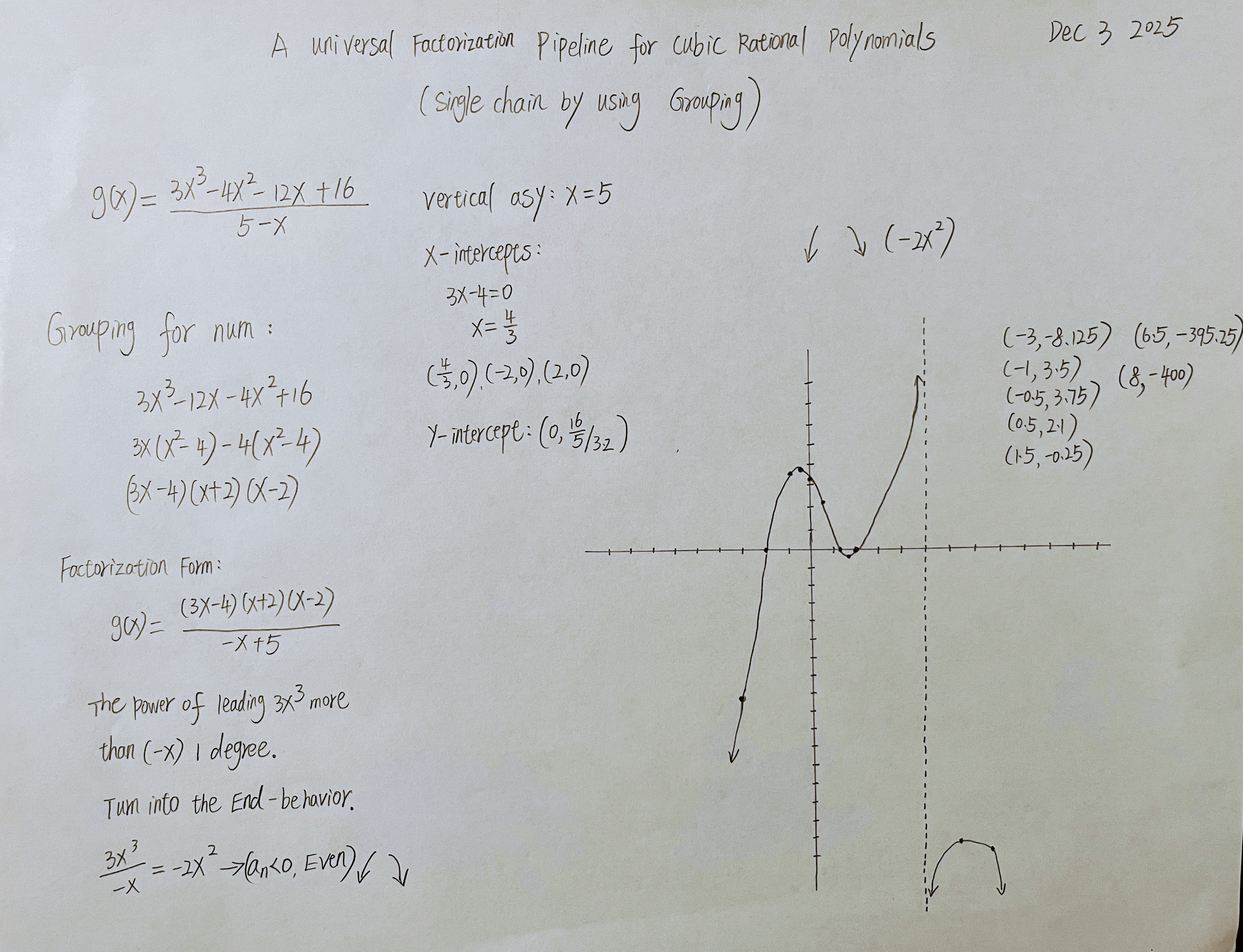
I attempted grouping first:
- Rearranging $3x^3 -12x -4x^2 + 16$
- Extracting common factors of $3x$ and $-4$
- Obtaining $(3x - 4)(x + 2)(x - 2)$
This was the “single-branch” solution: valid, but limited because it depends on the pretty equation.
4. Why a Pipeline Was Needed
Grouping works here, but:
- It fails for many cubics
- Synthetic division only works if the first guess is correct
- Pattern recognition is unreliable
- Quadratic factor leftovers often appear
So I needed a general algorithm rather than “whichever trick works”.
5. The Pipeline (General Algorithm)
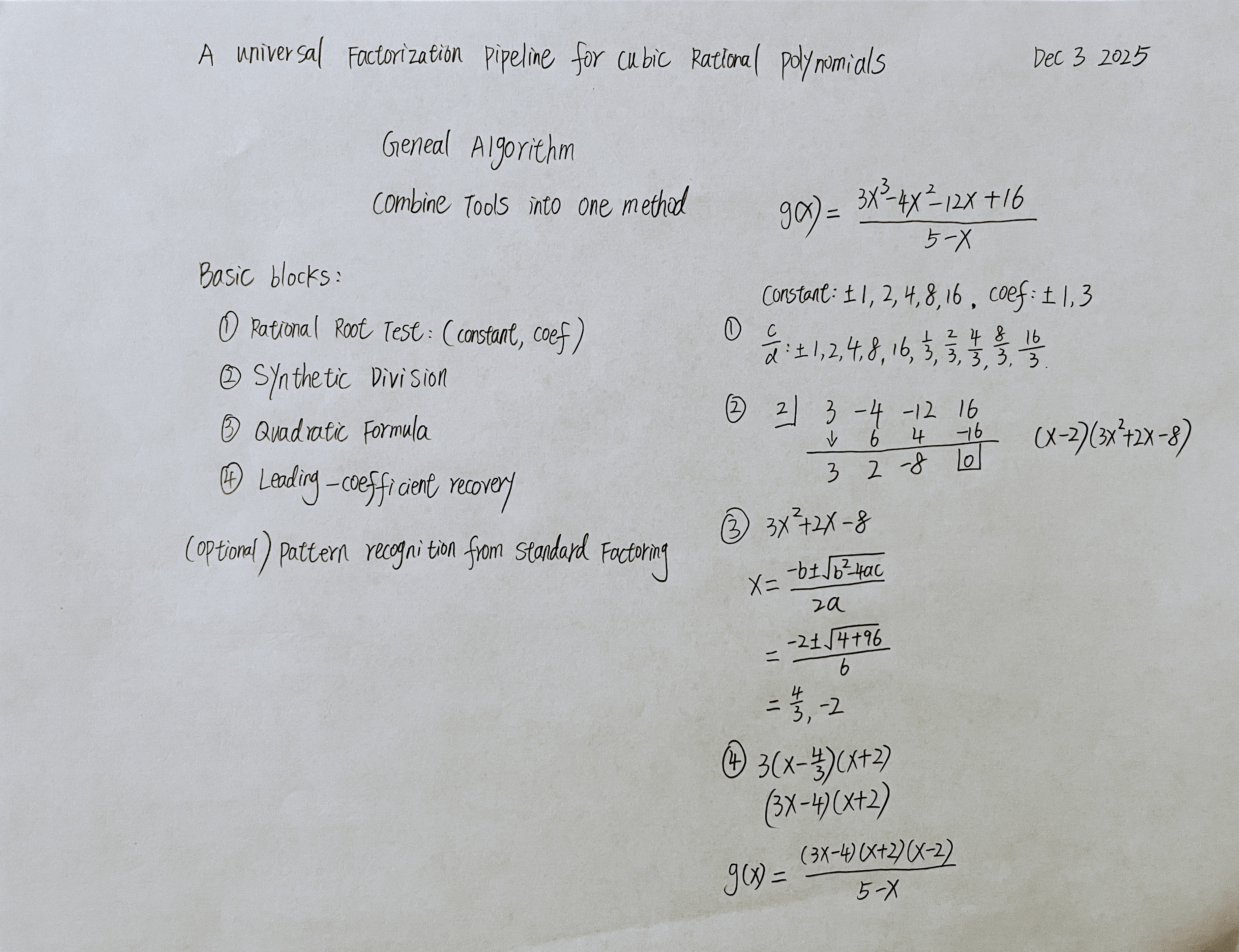
The method integrates four blocks:
-
Rational Root Test
Generate possible rational roots from (constant ÷ leading-coef). -
Synthetic Division
Test a candidate.
If the division succeeds → we can get a quadratic. -
Quadratic Formula
Solve the remainder quadratic directly, no guessing. -
Leading-Coefficient Recovery
Normalize the factorization back to the true leading term.
This converts a messy cubic into a fully deterministic pipeline.
6. Execution on the Example
Steps:
- RRT generates candidates like ±1, ±2, ±4, ±8, ±16, etc.
- Testing $(x = 2)$ succeeds.
- The remainder quadratic is $(3x^2 + 2x - 8)$.
- Quadratic formula → roots $\frac 4 3$ and $-2$.
-
Reassemble with leading coefficient recovery:
$3(x- \frac 4 3)(x+2)$ → $(3x-4)(x+2)$
7. Interpretation: Why This Works
This pipeline always terminates because:
- RRT guarantees the function eventually hits a rational zero (if one exists)
- Quadratic formula handles the remainder
- Leading-coefficient recovery preserves the original structure. Meanwhile, it can replace the A/C method that cannot handle the Leading-coef was Bigger/Odd.
- Every branch converges to the same final factorization
It is not a trick, and is an algorithm to form a unified structure for cubic factorization.
8. Closing Reflection
This was the first time I combined:
- [Transferring
grouping methodinto] - ① possible rational roots test
- ② synthetic division
- ③ quadratic formula
- ④ coefficient recovery [into a
single algorithm].
The point is not efficiency, but it has to master all methods to converge for a structure chain.
This document is preserved as the first “pipeline” that I built from college-algebra materials.