A Universal Factorization Pipeline for Cubic Rational Polynomials
I would like to refactor this rational polynomials after seen the grouping method many times.
Therefore, I built a factorization pipeline while solving a real problem in college algebra.
The refactoring steps are simple:
- Refactoring grouping method by utilizing the polynomial tools.
- Always execute this universal pipeline and do not rely on a “pretty” equation.
1. Mapping the Algebra Tools
There is no single-chain algorithm to combine all the tools for the arbitrary polynomials, and means that we choose which path works when we are solving it.
Thus, I need a factorization algorithm to stabilize the solving path for any polynomials inside the rational functions or not as a clear integer.
- Synthetic division is not used to finish the factorization, and the function is to remove the power layer until the quadratic form we have obtained.
- The A/C method cannot handle arbitrary leading coefficients well, especially when they are not clean integers.
2. Example Function

I started with the example:
$g(x) = \frac{3x^3 - 4x^2 - 12x + 16}{5 - x}$
The task is to identify the intercepts and asymptotes, graph the rational function.
Before graphing, the numerator must be factored.
3. Grouping Attempt
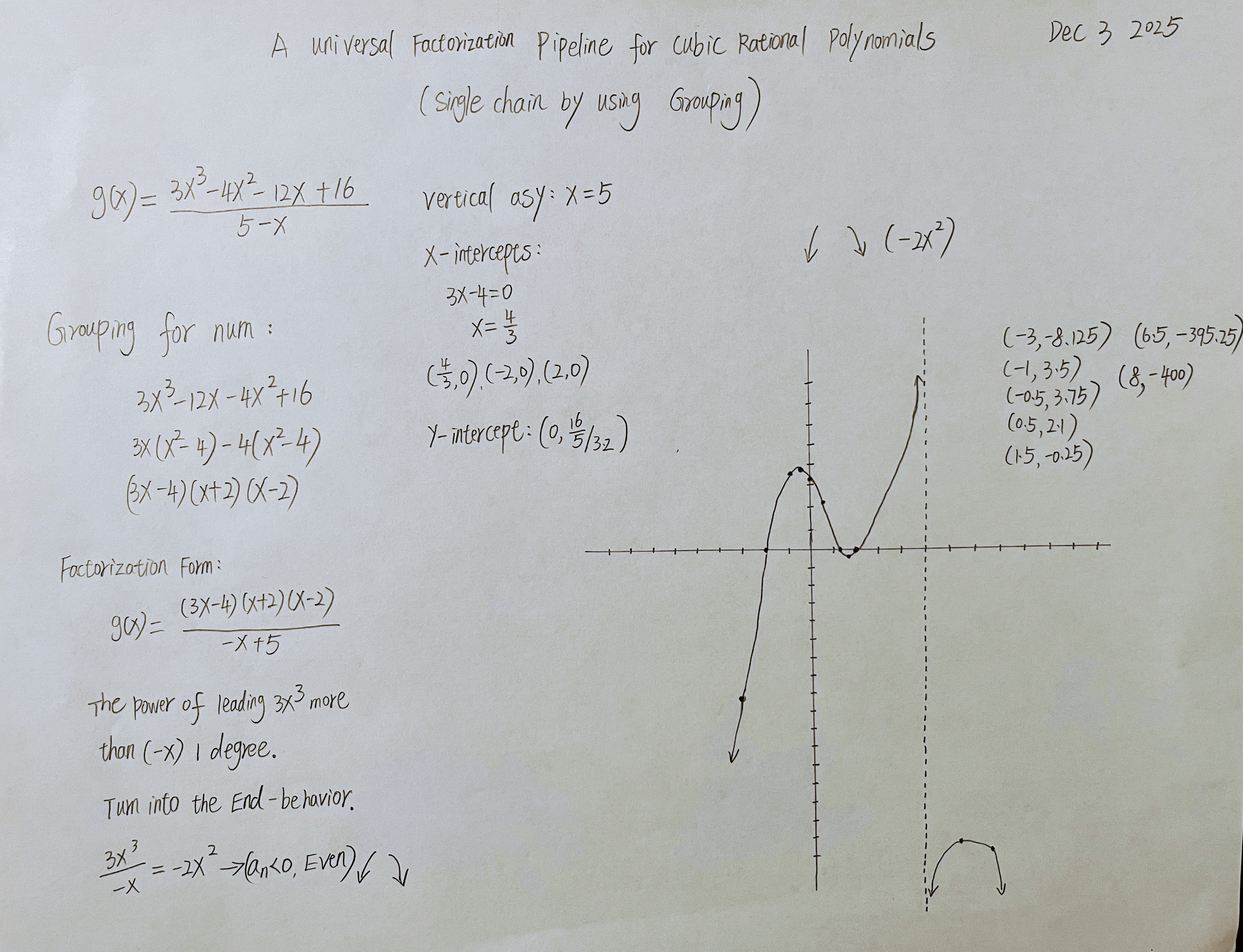
I tried grouping first due to the pretty equation.
- Rearranging $3x^3 -12x -4x^2 + 16$
- Extracting common factors of $3x$ and $-4$
- Obtaining $(3x - 4)(x + 2)(x - 2)$
Meanwhile, I also provided the end-behavior and graph solution.
But we can see the grouping method is to demonstrate here is a pretty equation for solving the demand.
4. The Pipeline for Refactor the Grouping (General Algorithm)
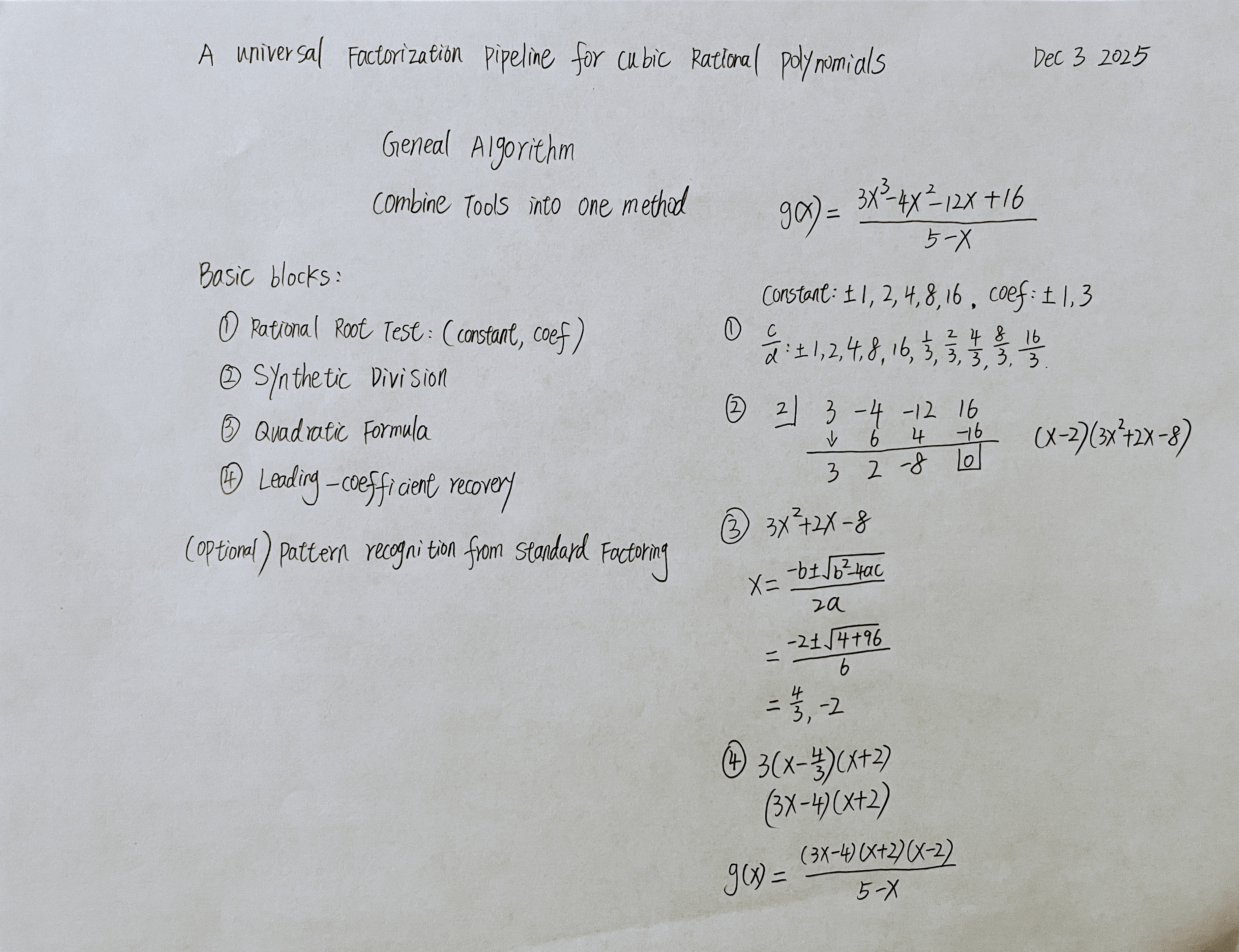
The solution was to utilize several tools and combine into one chain.
-
Rational Root Test
Generate possible rational roots from (constant ÷ leading-coef). -
Synthetic Division
Test a candidate frompossible rational rootsuntil we get a quadratic form. -
Quadratic Formula
Solve the remaining quadratic directly. -
Leading-Coefficient Recovery
Restore the original leading coefficient.
5. Execution on the Example
Steps:
- Rational Root Test produces candidates: ±1, ±2, ±4, ±8, ±16, …
- Testing $(x = 2)$ works.
- The remainder quadratic is $(3x^2 + 2x - 8)$.
- Quadratic formula gives: $\frac 4 3$ and $-2$.
-
Recover the leading coefficient:
$3(x- \frac 4 3)(x+2)$ → $(3x-4)(x+2)$
6. Repeat Why the General Algorithm is Better
- Avoid the A/C method in this scenario.
- Avoid the
groupingmethod.
Those are the single branch method, and it is not a universal pipeline.
7. Conclusion
This pipeline of algorithms has to combine all the polynomial tools for one single chain.
- ① possible rational roots test
- ② synthetic division
- ③ quadratic formula
- ④ coefficient recovery
This method is not efficient, but it practiced the maps of algebra in my mind.